
Guide on tea redensification for smallholders in Uganda
The guide to farmer-led tea plot redensification
Why redensify tea plots?
Most tea-producing areas in Uganda, including Kabarole and Kyenjojo districts where we work, experienced a dramatic decline in fresh tea leaf prices between 2015 and 2025.
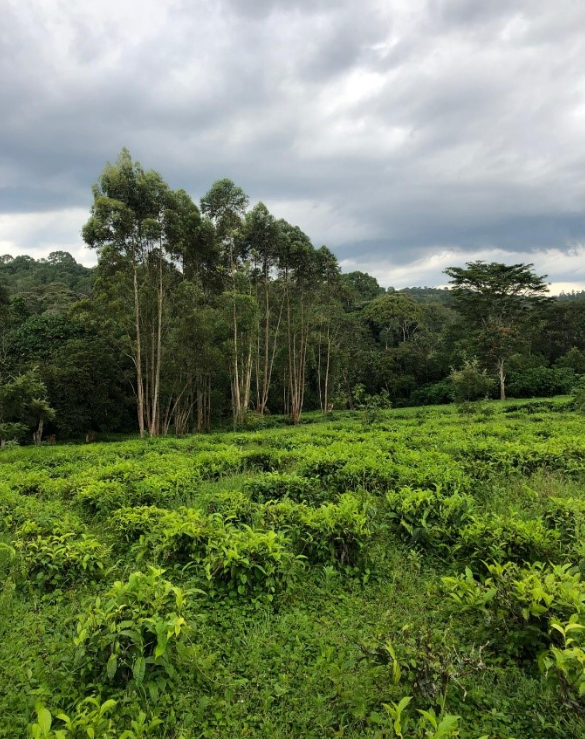
To cope, farmers reduced production costs by discontinuing essential practices such as replacing dead tea bushes, which is costly and labour-intensive. This led to a significant loss of tea plot density, as shown in the photo.

Low-density tea plot: the gaps left by dead tea bushes have not been filled.
The approach presented in the guide
This guide proposes a renewed approach to tea plot redensification, adapted to the labour and cash-flow constraints faced by smallholder farming households.
Unlike redensification based on costly clonal planting material, the method presented here relies on the improved relocation of wildlings, i.e. naturally occurring tea shoots.
This method reduces redensification costs by 50% while maintaining survival and growth rates equivalent to or higher than those of clonal plants, making redensification more accessible to smallholder farmers.
What impact does it have on biodiversity?
Our work to promote a redensification approach suited to smallholder farmers' constraints was carried out on the outskirts of Kibale National Park, with a clear objective: to help protect biodiversity. This farmer-led innovation contributes to this objective in two ways:
- Less glyphosate. Low-density tea plots are more vulnerable to weed growth, which farmers often manage through intensive glyphosate use. In sufficiently dense plantations, by contrast, tea bushes form a continuous canopy, greatly reducing the need for weeding and making manual weed control more manageable. Smallholder-led redensification can therefore substantially reduce, or even eliminate, glyphosate use in tea plots.
- A barrier against elephants. Dense tea plantations act as a barrier, helping to prevent elephants from the park from entering farmland. Redensifying tea plots can restore this barrier effect, protecting local communities and their food crops from elephant incursions while also reducing the risk of retaliatory action against elephants.
Benefits for household income and the wider farm
Denser tea plots can also generate higher yields and greater income for farmers. By providing a regular source of cash throughout the year, tea helps sustain the wider farm economy. This income can be used to purchase bean seeds, support farmers' diversification into coffee production, or cover quarterly school fees.

Engaging the private sector to scale up the approach
In collaboration with two tea factories on the outskirts of the park, we aim to train and support up to 5,000 smallholder farmers in this farmer-led approach to tea plot redensification, with the goal of improving their incomes and protecting biodiversity.